Summary: In 2019, the Allegheny County Board of Property Assessment Appeals and Review (BPAAR) heard 7,941 appeals of assessed values. Most were for residential properties and most were brought by governing bodies, particularly school districts. There is an anticipation that there may be an uptick in appeals due to the economic effects of the coronavirus. It’s yet another reason to have predictable reassessment cycles.
The overall pre-appeal assessed value of the cases heard by BPAAR was $2.577 billion. After appeals were heard the value was increased on 5,243 properties, decreased on 1,394 properties or stayed the same on 1,304 properties. The current total value of these parcels was $2.787 billion. This was a net increase of $210.7 million. Countywide taxable assessed value as of Jan. 1, 2020 was $81.6 billion according to the county assessment roll. The last countywide reassessment took effect in 2013.
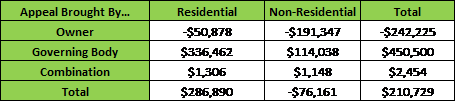
By property class, 7,069 appeals (89 percent) were for residential properties and 872 (11 percent) were for non-residential properties (mostly commercial, but also industrial, agricultural, utilities and other). The result of residential appeals was a $286.9 million net increase in value from pre- to current total value and for non-residential a net decrease of $76.2 million in value. A hotel had its value reduced by $14.7 million. That was the largest downward reduction last year. The properties rounding out the 10 largest reductions saw decreases from $4.5 million to just over $9 million from pre-appeal to current total value. These included shopping centers, an apartment building, an office building and department stores.
According to BPAAR rules, appeals can be brought by the owner of the property, taxing jurisdictions and any other person “whose direct pecuniary interests in the real estate would be affected by the assessment.” The 2019 data show that owners brought 2,257 appeals (28.4 percent), governing bodies 5,645 appeals (71.1 percent) and a combination of parties, 39 appeals (0.5 percent).
School districts brought the bulk of the appeals in the governing body group (5,635). All but six of the 43 school districts in the county filed a governing body appeal in 2019. There were three municipalities that filed the remaining 10 governing body appeals. With a long period since the last reassessment, changes in market value as indicated by recent sales drive governing body appeals. Of school district appeals on residential properties, nearly 60 percent of properties had a pre-appeal assessed value of $100,000 to $299,999.
Results of 2019 Appeals (Change in Value from Pre-Appeal to Current Total Value, $000s)
Comments in a news article, the latest County Controller’s “Taxpayer Alert” and at County Council’s public hearings on the 2021 budget raised the possibility that owner-initiated appeals of large commercial properties due to the coronavirus may have a significant impact on county finances, and, by extension, local finances in coming years.
BPAAR’s solicitor said there could be plenty of appeals from hotels and other commercial properties looking for relief. The alert stated that “a longer-term concern could be appeals to tax valuations of commercial properties which have lost tenants and earning potential during the pandemic.” Class A office space in Downtown had a vacancy rate of 15.9 percent in the fourth quarter of 2019 and the rate may have increased due to the coronavirus and people working from home (see Policy Brief Vol. 20, No. 11). Statements made at the budget hearings leave the impression that it is on the minds of county officials but the fiscal impact is undetermined. Of the $81.5 billion in taxable value, $25.4 billion (31 percent) is non-residential.
The annual appeal deadline is March 31, so it is probable that coronavirus-driven appeals would be filed by next March based on when the shutdown occurred. By the deadline date the county, municipalities in the county and Pittsburgh Public Schools will have already adopted their 2021 operating budgets. Decisions made by BPAAR can be appealed to the Board of Viewers.
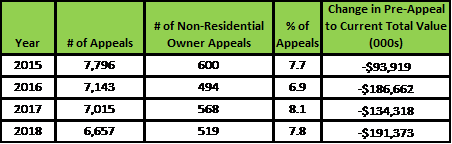
Does recent experience offer any clue about what could happen? Since 2015, the number of non-residential property appeals by owners has amounted to less than 10 percent of all appeals heard by BPAAR. Reductions have been won by office buildings, hotels, shopping malls and other properties. Some of those owners could come back for a further appeal due to the coronavirus and be joined by many others.
Non-Residential Owner Appeals, 2015-2018
Future non-residential appeals that are successful in reducing value will affect taxing bodies quite differently. While the county, the City of Pittsburgh and larger municipalities and school districts might be able to absorb a decrease in value, the same cannot be said for smaller governing bodies.
If the owner of a large non-residential property appeals an assessed value due to a downturn in business, loss of tenants, etc. and is successful that means the adjusted assessed value will be in place for many years until the next reassessment is undertaken. It’s another reason we advocate for regular reassessments, preferably every three years. That would put Pennsylvania in the range of when most states require reassessments (see Policy Brief Vol. 18, No. 33).
As has been noted before, the county’s leadership refuses to reassess, the state doesn’t want to force counties into a reassessment cycle (legislation to mandate a four-year cycle for all counties has not been formally introduced since its co-sponsorship memorandum was written in January 2019 and will likely expire with the legislative session) and appeals keep happening.
It is unconscionable that politicians continue to resist doing the right thing regarding reassessments, a long overdue and necessary step to keep them as close to market value and accurate as possible.
A predictable reassessment cycle would go a long way in not only restoring fairness to the property assessment process but in minimizing what could be a significant coronavirus-fueled uptick in appeals not only in Allegheny County but in other counties in the state with even older base-year assessments.